Ingestion: The Occlusion bodies are ingested by insect larvae. In the highly alkaline pH of the midgut, the occlusion body protein dissolves and is further degraded by hosts alkaline proteases.
Virus reproduction: : The virus strain is protected in a polygonal structured capsid which enables the virus to infect host cells easily and aids in reproduction of the virus. When the capsid is broken down inside the host, virus strains are released and begin reproduction. The virus particles are released from polyhedra and subsequently attach to the peritrophic membrane lining the midgut. The lipoprotein membrane surrounding the virus fuses with plasma membrane of the gut wall cells and liberates nucleocapsids into the cytoplasm. The nucleotide transport virus DNA into the nucleus of the cell and virus gene expression begins. The virus multiplies rapidly and eventually fills the body of the host with virus particles.
Infection: The host will become visibly swollen with fluid containing the virus and will eventually die - turning black with decay. A pale whitish fluid is released from the insects body within 2-5 days of application of at young larval stages. The infection of NPV is sometimes carried inside the infected pupae and adults. The caterpillars emerging out of the eggs layed by such adults also carry the Poly Inclusion Bodies of NPV.
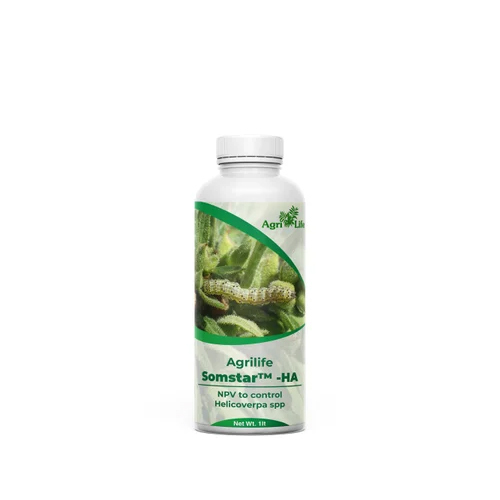
- Somstar - HA effectively controls economically important polyphagus pest Helicoverpa armigera and a few other sucking pests on a wide range of crops
- Pest load reduction leads to improved plant health and thereby increased crop productivity
- Somstar Ha can be used as an effective component in Integrated Pest Management (IPM) programmes, thereby leading to a reduction in use of chemical pesticides and creating a safer environment







 Send Inquiry
 Send Inquiry
 Send SMS
